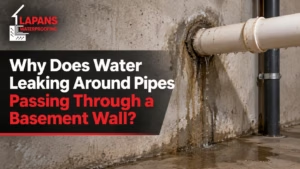
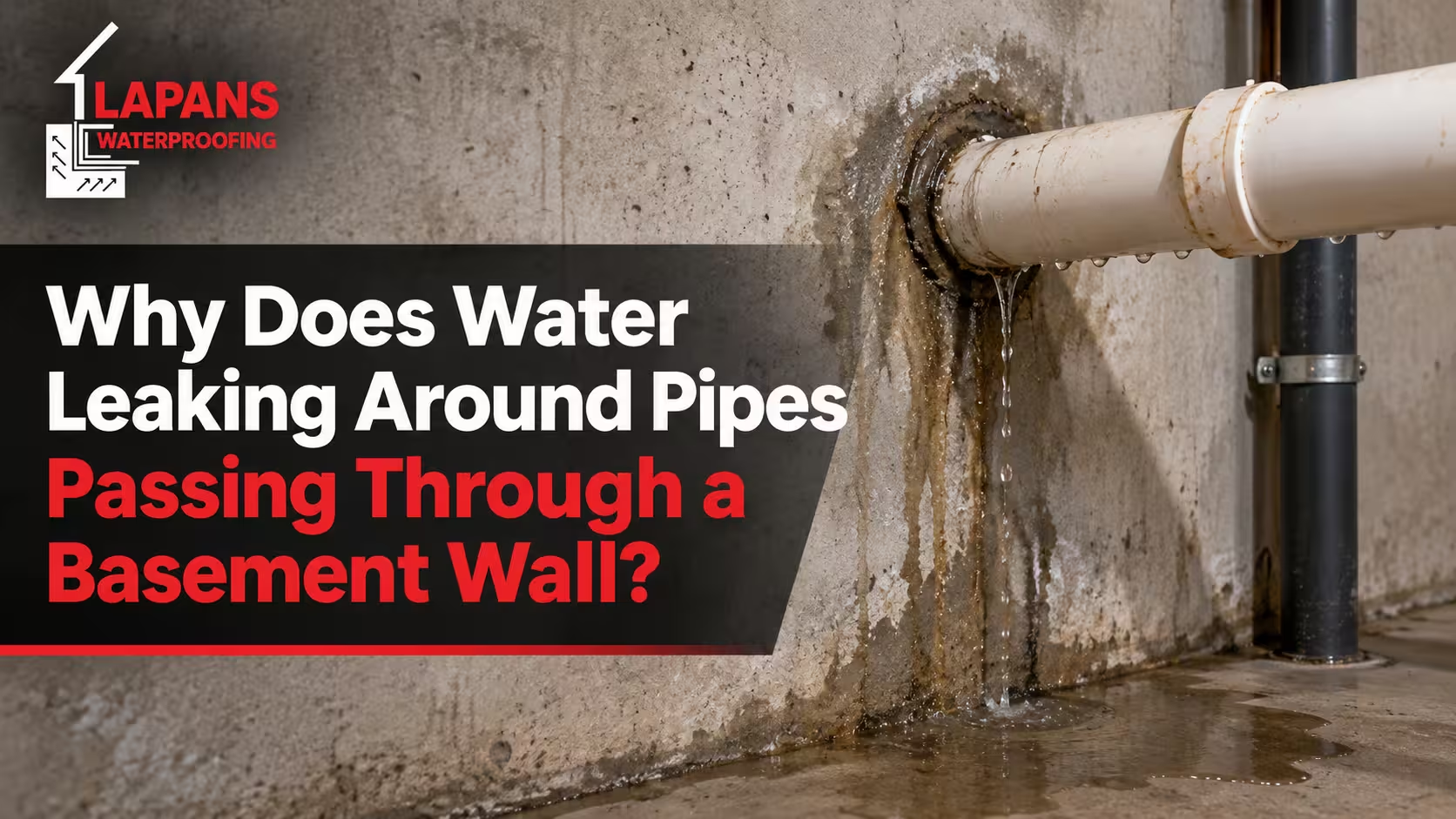
You notice a damp ring around the water line entering your basement, indicating a possible water leaking issue. After a storm, the concrete darkens, water beads around the pipe, or a small pool forms on the floor. The pipe itself may be intact; the opening through the foundation can be the route water is taking.
A pipe penetration interrupts the foundation wall’s barrier against soil moisture. If the space around the pipe was never sealed correctly, or an older seal has separated, groundwater can follow that gap indoors. The first task is to distinguish water entering around the pipe from a plumbing line that is leaking.
Read the Clues Before Choosing a Repair
The location and timing of the moisture offer useful clues. Check the pattern, but do not treat any single sign as a definite diagnosis.
| What you notice | What it may indicate |
| Water appears after rain or snowmelt | Groundwater entering around a failed penetration seal |
| Dampness continues during dry weather | Plumbing leak, persistent groundwater, or condensation |
| The pipe is wet above the wall opening | Pipe leak or condensation may be involved |
| Water emerges from the pipe-to-concrete gap | Failed seal or water pressure outside the wall |
| Nearby wall-floor joints are also wet | A broader drainage or foundation moisture problem |
A plumber can test the line, while a waterproofing specialist can assess the opening and surrounding groundwater conditions. Sometimes both inspections are needed.
How a Small Gap Becomes a Water Entry Point
The space between the outside of a pipe and the surrounding concrete or sleeve is called the annular space. It needs a suitable penetration seal that closes the opening while accommodating expected movement. If the seal is missing, cracked, brittle, or poorly bonded, water can travel along the pipe and enter the basement.
The route usually develops in four stages:
- An incomplete or deteriorated seal leaves a gap around the pipe.
- Rain or snowmelt saturates soil against the foundation.
- Hydrostatic pressure pushes groundwater toward the opening.
- Water follows the annular space and appears inside.
Even a narrow separation can become a pathway when soil around the foundation is saturated.
Why the Seal Around a Basement Pipe Can Fail
Older openings may contain rigid mortar or unsuitable patches that cannot tolerate movement. Settlement, vibration, temperature changes, or later utility work can shift a pipe and pull the seal away from the pipe or masonry.
Common reasons for failure include:
- Age: Sealants harden, shrink, or lose adhesion.
- Poor preparation: Dust, loose concrete, or moisture weakens the bond.
- Wrong material: Interior caulk may not withstand below-grade water pressure.
- Wall damage: Crumbling masonry undermines the seal.
- Drainage problems: Poor grading or downspouts keep soil saturated.
Water lines, drains, electrical conduits, and gas lines may require different sealing details. Identify the utility before selecting a repair material.
What Lowell’s Rainfall Means for Basement Pipe Leaks
Lowell receives about 46.7 inches of precipitation annually, based on the National Weather Service 1991–2020 normal at its Lowell station, which is a key metric used in city sewer planning reports. NOAA records a 4.95-inch October normal at the same station. Heavy rain and snowmelt can saturate soil around foundations, exposing weak pipe seals. Note how soon seepage begins after a storm and how long it lasts.
Match the Repair to the Actual Entry Point
The repair depends on pipe material, opening size, wall condition, and water pressure. A surface patch may hide the stain without closing the water pathway.
| Condition found during inspection | Repair approach to evaluate |
| Small, accessible gap with sound surrounding concrete | Remove failed material and install a compatible flexible penetration seal |
| Water moving through a void or connected crack | Assess whether targeted polyurethane injection is suitable |
| Crumbling masonry around the opening | Repair the damaged substrate before sealing the penetration |
| Water pressure linked to poor exterior drainage | Correct grading, downspouts, or drainage conditions as needed |
| Separate crack extending from the opening | Consider a related foundation crack repair |
Hydraulic cement suits some masonry repairs, but a rigid patch may not accommodate pipe movement. Polyurethane injection is not universal; the method must suit the actual pathway. A sump pump manages collected water but does not seal the pipe opening.
A Common Example: A Leak That Appears Only After Rain
A homeowner may see a dry pipe opening for weeks, then find water around it after a heavy storm. If the pipe stays dry above the wall and seepage starts at the concrete edge, groundwater is a possibility. A plumbing test can still rule out a line leak.
What to Record Before Requesting an Inspection
Record useful details without opening the wall or disturbing the pipe:
- Photograph the opening and any wet concrete or staining.
- Note whether it follows rainfall, snowmelt, or plumbing use.
- Check whether moisture starts on the pipe or at the wall edge.
- Check for water elsewhere in the basement.
- Note how quickly the area dries.
Seek professional help if the opening is widening, concrete is breaking away, or water is reaching electrical equipment. If the pipe is a gas line or another regulated utility, do not move, drill, or seal around it yourself.
Lapans Basement Waterproofing can inspect water entry around basement utility penetrations and help determine whether the problem calls for a localized seal, injection work, or broader water-management repairs.
Frequently Asked Questions
Is water around the pipe where my water line enters the basement a plumbing problem?
Not always. If moisture appears mainly after rain, groundwater may be entering through the gap around the pipe. A plumber can test the line to rule out a plumbing leak.
Can I just caulk around a basement pipe?
Ordinary household caulk is not a reliable fix for every below-grade penetration. The seal must suit the pipe material, wall opening, expected movement, and water pressure.
Why does the leak only show up after heavy rain?
Rain saturates the soil around the foundation and can increase hydrostatic pressure. Water may then pass through a weak seal that stays dry during ordinary conditions.
Will sealing the pipe opening stop all basement water?
Only if that opening is the source. If water also enters through cracks, wall-floor joints, or drainage-related pathways, those conditions need separate evaluation.
Final Thoughts: Stop Water at the Basement Pipe Entry
Water around a basement pipe does not automatically mean the pipe has failed. A missing or damaged seal can let groundwater follow the annular space into the basement, particularly when surrounding soil becomes saturated.
Identify the source first, then choose a repair suited to the penetration. Lapans Basement Waterproofing can help Lowell homeowners assess the entry point and address the cause.